Knowledge
How Does an RGB LED Tact Switch Work? A Simple Guide
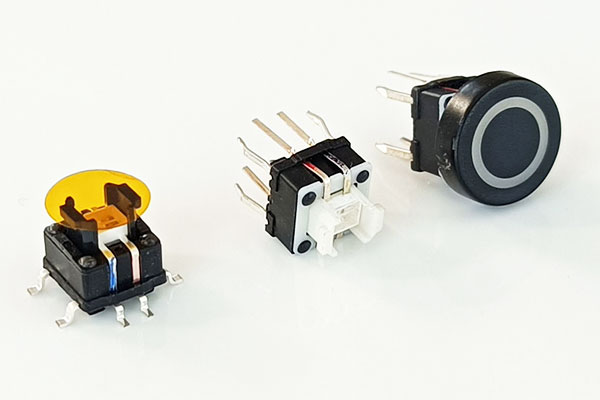
An RGB LED tact switch combines a momentary tactile switch and a multi-color LED into a single compact component. It serves two distinct functions simultaneously: closing an electrical circuit when pressed and providing customizable visual feedback.
The Mechanical Switch Mechanism
The switch portion operates on a basic momentary contact principle:
The Metal Dome: Inside the switch sits a tiny, curved metal dome. This dome acts as both a mechanical spring and a movable electrical contact.
The Actuation: When you press the switch casing, it pushes down on this dome. The dome suddenly snaps downward, giving you a distinct, physical "click" feeling (tactile feedback).
Circuit Closure: As the dome snaps down, its underside touches a stationary contact on the bottom of the switch housing. This bridges the gap between two terminal pins, completing the circuit and allowing current to flow to your microcontroller or device.
The Release: When you remove your finger, the mechanical tension in the metal dome forces it to spring back to its original curved shape. This breaks the electrical connection instantly, turning the circuit off.
The RGB LED Component
The illumination part houses three tiny, independent Light Emitting Diodes (LEDs) built into the translucent button cap: Red, Green, and Blue.
Pin Configuration: These LEDs usually share a common terminal. In a Common Cathode setup, all three LEDs share a single negative ground pin, while three separate positive pins control each color. In a Common Anode configuration, they share a single positive power pin, and three separate negative pins control the colors.
Color Mixing: By sending electrical current to specific pins, you light up individual colors. To create colors beyond just red, green, or blue, you use a technique called Pulse Width Modulation (PWM). PWM rapidly blinks the individual LEDs on and off at varying intervals.
Visual Synthesis: This rapid blinking happens too fast for the human eye to see. Instead, our eyes blend the intensities together. For example, lighting Red and Blue equally creates purple, while mixing all three at full brightness produces white.
By separating the switch terminals from the LED pins, the component allows external systems to change the button's color dynamically based on system states—such as turning green for "ready," flashing red for "error," or glowing blue for "standby."
In conclusion, illuminated RGB tact switches are a popular choice for many electronic applications due to their small size and attractive appearance. They are easy to use and can be programmed to display any color or pattern. The working principle of the tact switch with RGB LED is simple, and it can be easily incorporated into any design. Tact switches with RGB LED are likely to become even more popular in the future, as the demand for colorful and customizable electronic components continues to grow.
RELATED NEWS
- Why Do Customers Prefer Right Angle LED Tact Switch 2026-08-24
- Why Choose Metal Push Button Switches with Pre-Wired Cable 2026-07-28
- Why Do Customers Choose Wired Metal Push Button Switches 2026-06-24
- What is a metal push button switch used for 2026-05-19
- The most common problems with DIP switches 2026-04-01
CATEGORIES
LATEST NEWS
CONTACT US
Contact: Bella
Phone: 15999819066
E-mail: rucoe@rucoe.com
Whatsapp:+86-15999819066
Add: Taoyuan Street, Nanshan, Shenzhen