Knowledge
Can a metal button switch be integrated with indicator lights
metal button switches can be fully integrated with indicator lights—this combination is widely used in industrial control panels, household appliances, and automotive systems to provide visual confirmation of switch state or circuit status . The integration typically embeds light sources (most commonly LEDs) within the switch housing, aligned with the metal actuator to ensure visibility without compromising the switch’s mechanical performance. Below is a detailed breakdown of integration feasibility and voltage options:
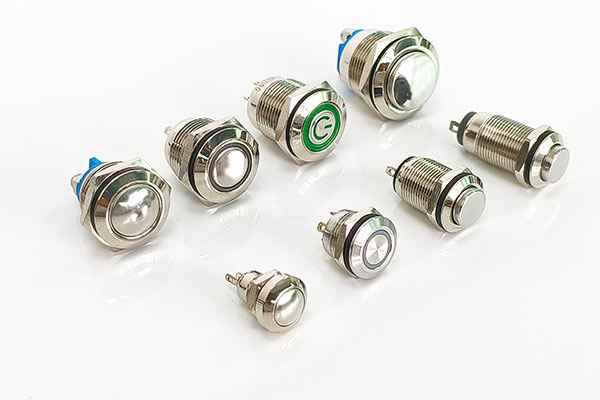
Modern illuminated metal button switches (both momentary and latching types) are engineered with modular designs to accommodate indicator lights . Key integration features include:
1. Embedded Light Sources: LEDs are the primary choice due to their compact size, low power consumption, and compatibility with low-voltage systems. For example, Siemens SIRIUS ACT switches integrate red, green, yellow, or white LEDs directly into 22mm/30mm metal-button housings .
2. Dedicated Terminals: Switches includes separate contacts for RGB indicator lights, allowing independent control of illumination via a microcontroller or PLC .
3. Environmental Compatibility: Industrial-grade integrated switches (e.g., RAFI’s Lumotast 16) maintain IP67/IP65 protection despite housing lights, making them suitable for harsh environments .
Common Voltage Options for Indicator Lights
Voltage ranges are determined by the light source type (LED vs. incandescent) and application scenario (low-voltage industrial vs. mains-powered consumer devices).
1. Low-Voltage DC (6V–48V)
The most prevalent range for industrial and automotive applications, aligned with standard control system voltages:
6V–12V: Used in automotive dash switches and low-power devices. For instance, 12V LEDs are integrated into car window control buttons to indicate activation .
24V: Dominant in industrial automation (e.g., PLC-controlled panels). Siemens SIRIUS ACT switches operate reliably at 24V DC, matching typical factory control circuit voltages .
36V: Found in heavy-duty equipment (e.g., construction machinery) where higher voltage is needed for brighter illumination without increasing current .
2. Mains Voltage (110V–240V AC/DC)
Used in household appliances and high-power industrial systems, often requiring voltage regulation:
110V–120V AC: Common in North American household switches (e.g., oven control buttons) with incandescent or AC-LED indicators .
220V–240V AC/DC: Standard for European/Asian appliances and high-voltage control panels. The XTBK-6000/QT switch controller, for example, uses 220V LED indicators to show breaker status in 2KV–35KV electrical cabinets .
3. Specialized Low-Voltage (≤5V)
For compact electronic devices and IoT systems:
3.3V–5V: Integrated into small metal push buttons for consumer electronics (e.g., smart home control panels). These use surface-mount LEDs optimized for low-power MCU circuits .
4. Incandescent Light Sources (Legacy Option)
Older switches may use miniature incandescent bulbs, typically operating at 1.5V–6V DC . However, they are largely replaced by LEDs due to shorter lifespans and higher energy consumption.
Voltage Selection Considerations
System Compatibility: Match indicator voltage to the metal switch’s control circuit (e.g., 24V for industrial PLC systems, 12V for automotive) .
Light Source Limitations: LEDs require current-limiting resistors to avoid burnout at higher voltages (e.g., a 24V LED in a 48V circuit needs a series resistor) .
Safety Standards: Mains-voltage indicators must comply with IEC 62477-1 or GB 4943.1 to ensure insulation from the metal actuator .
RELATED NEWS
- Why Do Customers Prefer Right Angle LED Tact Switch 2026-08-24
- Why Choose Metal Push Button Switches with Pre-Wired Cable 2026-07-28
- Why Do Customers Choose Wired Metal Push Button Switches 2026-06-24
- What is a metal push button switch used for 2026-05-19
- The most common problems with DIP switches 2026-04-01
CATEGORIES
LATEST NEWS
CONTACT US
Contact: Bella
Phone: 15999819066
E-mail: rucoe@rucoe.com
Whatsapp:+86-15999819066
Add: Taoyuan Street, Nanshan, Shenzhen