Knowledge
The difference between a momentary and a latching metal button switch
The primary distinction between momentary and latching metal Push button switches lies in how they maintain contact state after actuation, which directly impacts their function in circuits and use cases.
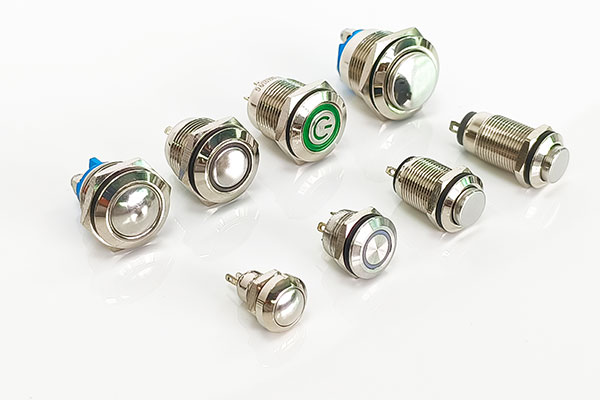
1. Operational Principle & Contact State
Momentary metal Switches: These switches only maintain a closed (conducting) circuit while physical pressure is applied to the button. When the button is released, a built-in spring resets the switch to its default open (non-conducting) state. Their action is temporary—power or signal flows only during pressing. For example, a doorbell button: pressing it closes the circuit to trigger the chime, and releasing it cuts power immediately.
Latching metal pushbutton Switches: Also called “maintained-contact” switches, they lock into either open or closed state after a single press, requiring a second press to reset. They have no spring-return mechanism; instead, internal components (like a toggle or detent) hold the contact position. A common example is a lamp switch: one press closes the circuit to turn the light on, and a second press opens it to turn the light off—no constant pressure is needed.
2. Circuit Role & Feedback
Momentary metal push button switches excel at temporary actions: triggering alarms, sending signals (e.g., industrial control panels), or activating momentary functions (e.g., car horn). Their tactile feedback is often crisp and immediate, letting users know the switch is active only during pressing.
Latching switches handle sustained states: maintaining power to devices (e.g., appliances, power tools) or toggling between modes (e.g., fan speed settings). Their feedback is a “click-and-lock” sensation—users feel the switch settle into a position, confirming the state change will persist.
3. Durability & Design Nuances
Both use metal construction for robustness (resisting corrosion, impact, and high temperatures), but latching switches often have more complex internal mechanics (to support locking) than momentary switches (which rely on simple springs). This can make latching switches slightly bulkier, though both are available in compact industrial-grade designs.
RELATED NEWS
- Why Do Customers Prefer Right Angle LED Tact Switch 2026-08-24
- Why Choose Metal Push Button Switches with Pre-Wired Cable 2026-07-28
- Why Do Customers Choose Wired Metal Push Button Switches 2026-06-24
- What is a metal push button switch used for 2026-05-19
- The most common problems with DIP switches 2026-04-01
CATEGORIES
LATEST NEWS
CONTACT US
Contact: Bella
Phone: 15999819066
E-mail: rucoe@rucoe.com
Whatsapp:+86-15999819066
Add: Taoyuan Street, Nanshan, Shenzhen