Guides
Momentary vs Latching Metal Push Button Switches
When selecting a metal push button switch for an industrial control panel, charging station, or electronic device, one of the first decisions is whether to use a momentary or latching model. Although both types may have a similar stainless steel housing and panel-mount design, they operate differently and serve different control functions.
Understanding the difference between a momentary vs. latching metal push button switch helps equipment manufacturers choose the right switching action, avoid control circuit mismatches, and confirm the correct specifications before placing an order.
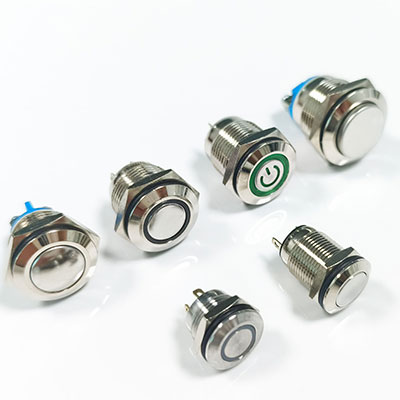
1. How Do Momentary and Latching Metal Push Button Switches Work?
The main difference is what happens when the operator releases the actuator.
A momentary metal push button switch changes its contact state while the button is pressed and returns to its normal state when released. For a normally open (NO) contact, pressing the button closes the circuit, and releasing it opens the circuit again. This is commonly described as an OFF-(ON) function.
A latching metal push button switch, by comparison, maintains its changed state after the button is released. In a typical push-on/push-off design, the first press changes the contact state, and the next press returns it to the original state. The circuit remains in its selected state until the switch is operated again or the control system changes it.
Feature
| Item | Momentary Metal Push Button | Latching Metal Push Button |
| Contact behavior | Returns when released | Maintains the selected state |
| Typical operation | Press and hold, then release | Press once to change state |
| Common function | OFF-(ON) | ON/OFF or maintained switching |
| Typical applications | Reset, jog, trigger, test | Power control, mode selection, maintained commands |
| Control requirement | Often requires a sustained press for direct operation | Can maintain a command without continuous pressure |
The exact contact behavior depends on the switch design. Buyers should confirm whether the selected model is normally open, normally closed, or configured with both contact types, rather than relying on the appearance of the button alone.
For panel designs that require a command only while the operator is pressing the button, consider a momentary metal push button switch. For applications that require a maintained switching state, explore the available latching metal push button switches.
2. When Should You Choose a Momentary Metal Push Button Switch?
A momentary switch is suitable when the equipment needs a temporary command rather than a continuously maintained state. Releasing the button automatically rebacks its contacts to their normal position, making it useful for operator inputs that should remain active only during the press.
Common applications include:
1. Reset buttons: Used to initiate a reset command on control panels, electronic instruments, and industrial equipment.
2. Jog and inching controls: Allow operators to move a motor or mechanism while holding the button, provided the control circuit is designed for this operation.
3. Test and trigger inputs: Send a temporary signal to a controller, measurement device, or electronic circuit.
4. Door release and access control: Provide a momentary input to a controller that operates an electric lock or release mechanism.
Related product: View Momentary Metal Push Button Switches
3. When Should You Choose a Latching Metal Push Button Switch?
A latching metal push button switch is a better fit when the equipment needs to maintain a selected contact state after the operator releases the button. This reduces the need to hold the button continuously and can simplify the operator interface for certain control functions.
Typical applications include:
Power control: Used as an input for turning equipment on or off when the circuit is designed for maintained switching.
Mode selection: Maintains a selected operating mode or control command until the switch is operated again.
Charging and energy storage equipment: Can provide a maintained input for a control system, depending on the equipment's electrical design.
Industrial control panels: Supports maintained commands where the operator needs a clear, repeatable switching action.
Commercial and professional equipment: Provides a compact metal control interface for machines, test equipment, and other panel-mounted devices.
Related product: View Latching Metal Push Button Switches
4. How to Check Contact Configuration and Electrical Ratings Before Purchasing
Once the switching action has been selected, buyers should verify the contact arrangement and electrical parameters against the equipment's circuit requirements. Two metal push button switches with the same mounting diameter and head style may not be interchangeable.
a. Check the Contact Configuration
Start by confirming the required number and type of contacts.
1NO: One normally open contact. The circuit closes when the switch operates, assuming the specified NO contact action.
1NC: One normally closed contact. The circuit opens when the switch operates.
1NO+1NC: One normally open and one normally closed contact, which can support different circuit requirements when wired appropriately.
Also confirm whether the contact action is momentary or maintained. Terms such as OFF-(ON), ON-(OFF), and ON/OFF describe switching behavior and should be checked against the manufacturer's wiring diagram or datasheet.
b. Verify Voltage and Current Ratings
Check the rated voltage and current for the actual load, not just the control panel's nominal supply voltage. A switch rated for a particular resistive load may have a different allowable rating for an inductive load, motor, or capacitive load.
For procurement and engineering review, confirm:
Rated voltage and current, including AC or DC operation.
Load type, such as resistive, inductive, or capacitive.
Contact material and expected electrical service life, where specified.
Applicable switching frequency and operating conditions.
Whether an external relay, contactor, or electronic controller is required.
c.Confirm Mechanical and Environmental Requirements
For OEM and ODM projects, it is useful to provide the manufacturer with the following information before requesting a quotation:
Required switching action: momentary or latching.
Panel cut-out diameter and available installation space.
Contact configuration: 1NO, 1NC, or 1NO+1NC.
Operating voltage, current, and load type.
Terminal or wiring requirements.
Required IP rating, head style, and LED configuration, if applicable.
Expected operating conditions and service-life requirements.
These details help the manufacturer identify a suitable model and reduce the risk of ordering a switch that fits the panel but does not meet the circuit requirements.
d. Choose the Right Metal Push Button Switch for Your Application
The choice between a momentary and a latching metal push button switch comes down to the required control behavior. Choose momentary operation when the circuit needs a temporary input that returns when released. Choose latching operation when the switch must maintain its selected contact state after the operator releases it.
Before finalizing a model, check the switching mechanism, contact configuration, electrical ratings, mounting dimensions, and environmental requirements together. For equipment manufacturers and distributors, confirming these specifications early can help prevent compatibility issues during assembly and testing.
FVWIN offers metal push button switch options for different panel control requirements. Contact the team with your target cut-out size, switching action, contact configuration, and electrical specifications to identify a suitable model for your application.
CATEGORIES
LATEST NEWS
CONTACT US
Contact: Bella
Phone: 15999819066
E-mail: rucoe@rucoe.com
Whatsapp:+86-15999819066
Add: Taoyuan Street, Nanshan, Shenzhen